

Study shows that mechanical contraction by an app-controlled electrical device enhances wound healing
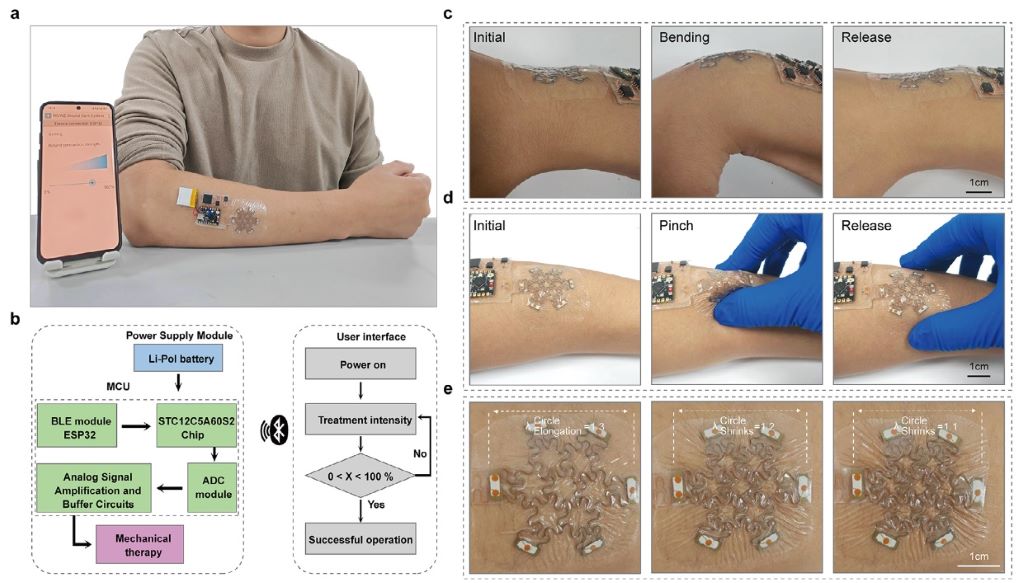
Skin is our protective barrier from the outside world, and it is highly susceptible to damage. To prevent infection, restore protective skin cells, and reduce scarring, it is essential to quickly and robustly close a wound. A new study, published by Wiley in Advanced Science, showed that a multi-axis stretchable wound zipper (MSWZ) is effective in closing complex wounds quickly, improving wound healing. The MSWZ uses programmable force that can be personalised via mobile application, enhancing patient comfort and compliance.
Current conventional approaches, such as sutures, cannot adapt to complex wound shapes and require healthcare professionals for their application. New alternatives, like temperature-responsive contractile dressings, are promising, yet can be unpredictable, compromised by environmental factors, and insufficient in their force to close a wound. Flexible bioelectronic systems enable precise control of mechanical contraction, though they have not yet been used in wound healing.
To utilise flexible bioelectronic systems for wound healing, researchers designed the MSWZ. The MSWZ is made up of a mechanical metamaterial in a lattice structure that shrinks and responds like human skin, a reliable conductive layer, and a breathable, flexible encapsulation material. Biocompatible and comfortable, the MSWZ stretches in six directions to accommodate complex wound morphologies, is wearable even on high-strain areas of the skin, and can be controlled through an app.
In rats, the pre-stretched MSWZ outperformed surgical suturing in the repair of linear wounds. For circular wounds, the pre-stretched MSWZ restored the epithelial barrier, decreased the wound width, and enhanced reconstruction of the collagen matrix. The MSWZ was effective in healing spindle- and oval-shaped wounds, which are most common in the clinic. Using immunohistochemistry, the researchers showed that pre-stretched MSWZ promotes blood flow to supply energy and nutrients for wound healing and supports matrix remodeling to reduce scar formation.
These findings suggest that the MSWZ enables rapid and robust wound healing at a molecular level. The MSWZ is easy to use, personalized, and programmable, adapting to complex wound types and the patient’s comfort level.
“Traditional wound closure methods, such as sutures or skin staples, not only contract in a single direction—making them unsuitable for complex wound shapes—but also fail to allow for quantification of the applied closure force. Our novel ‘multi-axis stretchable zipper’ addresses these limitations. Constructed from shape-memory alloy metamaterials, it can freely stretch in six directions to conform to any complex wound and enables precise, programmable mechanical contraction via a smartphone. We believe this technology offers an innovative solution for future wound care, ultimately alleviating patient suffering and significantly accelerating the healing process,” said senior author Yiming Zhang, PhD, of Xinqiao Hospital at Army Medical University in Chongqing, China.
Additional information
NOTE: The information contained in this release is protected by copyright. Please include journal attribution in all coverage. For more information or to obtain a PDF of any study, please contact: Sara Henning-Stout, newsroom@wiley.com
Full Citation:
“Multi-axis stretchable zippers for personalized wound healing.” Siyuan Cai, Guang Yao, Zijian Chen, Shiqi Zhou, Peisi Li, Liheng Lin, Huake Yang, Ziyi Zhou, Linbo Jin, Xingyi Gan, Chenzheng Zhou, Zhen Cai, Taisong Pan, Min Gao, Dongli Fan, Yuan Lin, and Yiming Zhang. Advanced Science; Published Online: June 11, 2026 (DOI: 10.1002/advs.75744).
URL: http://doi.wiley.com/10.1002/advs.75744
Source: Wiley
