Long-term use of medications for heartburn and acid reflux, known as proton pump inhibitors, does not appear to increase the risk of stomach cancer, according to a new study published in The BMJ. The results are based on extensive Nordic health data and may provide reassurance to patients who need long-term treatment, according to researchers at Karolinska Institutet.
The possibility that proton pump inhibitors could cause stomach cancer has been discussed since the 1980s. Overall, studies have shown a doubled risk, but the studies have had methodological shortcomings. To investigate the association, taking into account a number of possible sources of error in previous literature in the field, researchers analysed registry data from the five Nordic countries – Denmark, Finland, Iceland, Norway, and Sweden – over a period of up to 26 years.
The study included 17 232 people with stomach cancer and compared them with over 172 000 control subjects matched for age, sex, year, and country. The researchers investigated the use of proton pump inhibitors and another type of acid-suppressing drug, histamine-2 receptor blockers.
To avoid methodological errors, drug use in the last year before diagnosis was excluded, as were patients who had cancer in the upper part of the stomach, where heartburn is a risk factor. The results were also adjusted for factors such as Helicobacter pylori infection, stomach ulcers, smoking, alcohol-related diseases, obesity, diabetes, and certain medications.
By using this methodological approach, the researchers found no association between long-term use of these drugs and the risk of stomach cancer.
“Our results contradict the hypothesis that proton pump inhibitors cause stomach cancer,” says the lead researcher responsible for the study, Professor Jesper Lagergren at the Department of Molecular Medicine and Surgery, Karolinska Institutet. He continues:
“This provides reassurance for patients who need long-term treatment and is important for clinical decisions.”
The researchers emphasise that the study is observational, which means that no definitive conclusions can be drawn about cause and effect. Nor can it be completely ruled out that confounding factors that could not be adjusted for have influenced the results. However, the study design allows for more reliable results than previous research.
Researchers have discovered that stomach cancers in mice make electrical connections with nearby sensory nerves and use these malignant circuits to stimulate the cancer’s growth and spread.
Reported in Nature, this is the first time that electrical contacts between nerves and a cancer outside the brain have been found, raising the possibility that many other cancers progress by making similar connections.
“We know that many cancers exploit nearby neurons to fuel their growth, but outside of cancers in the brain, these interactions have been attributed to the secretion of growth factors broadly or through indirect effects,” says Timothy Wang, the Silberberg Professor of Medicine at Columbia University Vagelos College of Physicians and Surgeons, who led the study and is one of the leaders in the growing field of cancer neuroscience.
“Now that we know the communication between the two is more direct and electrical, it raises the possibility of repurposing drugs designed for neurological conditions to treat cancer.”
The wiring of neurons to cancer cells also suggests that cancer can commandeer a particularly rapid mechanism to stimulate growth.
“There are many different cells surrounding cancers, and this microenvironment can sometimes provide a rich soil for their growth,” Wang says. Researchers have been focusing on the role of the microenvironment’s immune cells, connective tissue, and blood vessels in cancer growth but have only started to examine the role of nerves in the last two decades.
“What’s emerged recently is how advantageous the nervous system can be to cancer,” Wang adds. “The nervous system works faster than any of these other cells in the tumour microenvironment, which allows tumours to more quickly communicate and remodel their surroundings to promote their growth and survival.”
Cancer-neuron connections resemble synapses
As a gastroenterologist, Wang’s research has focused on stomach and other GI cancers. About 10 years ago, he discovered that cutting the vagus nerve in mice with stomach cancer significantly slowed tumour growth and increased survival rate.
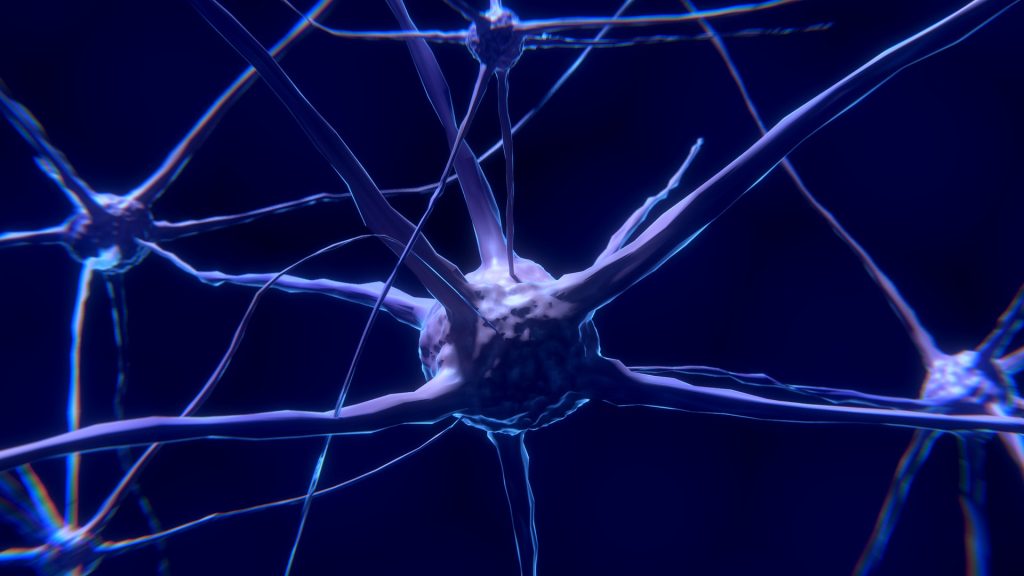
Many different types of neurons are contained in the vagus nerve, but the researchers focused here on sensory neurons, which reacted most strongly to the presence of stomach cancer in mice. Some of these sensory neurons extended themselves deep into stomach tumours in response to a protein released by cancer cells called Nerve Growth Factor (NGF), drawing the cancer cells close to the neurons. After establishing this connection, tumours signalled the sensory nerves to release the peptide Calcitonin Gene Related Peptide (CGRP), inducing electrical signals in the tumour.
Though the cancer cells and neurons may not form classical synapses where they meet – the team’s electron micrographs are still a bit fuzzy – “there’s no doubt that the neurons create an electric circuit with the cancer cells,” Wang says. “It’s a slower response than a typical nerve-muscle synapse, but it’s still an electrical response.”
The researchers could see this electrical activity with calcium imaging, a technique that uses fluorescent tracers that light up when calcium ions surge into a cell as an electrical impulse travels through.
“There’s a circuit that starts from the tumour, goes up toward the brain, and then turns back down toward the tumour again,” Wang says. It’s like a feed-forward loop that keeps stimulating the cancer and promoting its growth and spread.”
Migraine drugs as a potential cancer treatment
For stomach cancer, CGRP inhibitors that are currently used to treat migraines could potentially short-circuit the electrical connection between tumours and sensory neurons.
In Wang’s study, CGRP inhibitors administered to mice with stomach cancer reduced the size of the tumors, prolonged survival, and prevented the tumors from spreading.
“Based on our analysis of stomach cancer data from patients, we believe that the circuits we’ve found in mice also exist in humans and targeting them could be an additional useful therapy,” Wang says.
Sensory neurons may also use CGRP to stimulate cancer through more indirect pathways. Unpublished findings from Wang’s lab suggest that the neurons promote stomach cancer growth via contact with connective tissue cells in the tumour microenvironment. And other researchers have found that sensory nerves may, possibly through CGRP, cause T cell exhaustion and turn off immune responses directed at other types of cancers.
“But we think it all starts with the cancer cell setting up a neural circuit,” Wang says.
“Nerves are an underappreciated master regulator of normal growth and regeneration in animals. We know that when organs form during development, the nerves lead the way. From that point of view, it was not unexpected that nerves would be driving tumour growth as well.”