

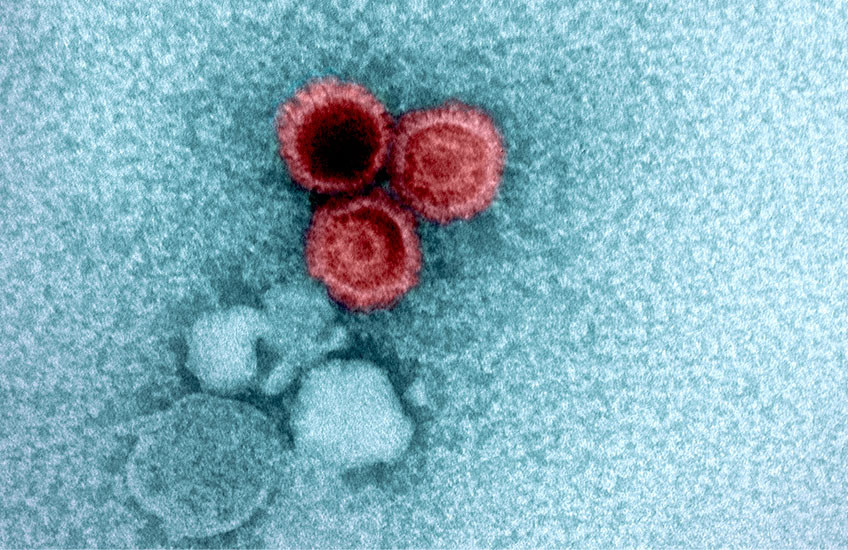
Some viruses are cleared by the immune system within days, while others lurk in our bodies for a lifetime and reemerge later to cause new problems. How and why viral levels in the body change over time – and the health impacts of these changes – are only just starting to become clear.
A team led by scientists at Harvard Medical School, Massachusetts General Hospital, Brigham and Women’s Hospital, and the Broad Institute of MIT and Harvard recently reported the largest analysis to date of the human DNA virome – the collection of viruses in the body that have DNA as their genetic material.
The researchers tracked the viral load – the amount of viral DNA – for several common viruses in blood and saliva from over 900 000 individuals. They saw large variations in viral load from person to person depending on age, sex, lifestyle, and other factors, and discovered dozens of genetic factors strongly associated with viral load.
The team concluded that genetics plays a role in determining whether the effects of these viruses extend well beyond an initial infection.
“We’re getting to the point now where we can use human genetics to try to answer fundamental questions about pathology resulting from viruses,” including whether a virus is likely to play a role in causing cancer or other diseases later in life, said first author Nolan Kamitaki, research fellow in genetics in the Blavatnik Institute at HMS.
The findings published March 25 in Nature.
Unexpected patterns emerge
Study co-senior author Po-Ru Loh, HMS associate professor of medicine at Brigham and Women’s and an associate member at the Broad Institute, is broadly interested in the scientific information that can be mined from population-level datasets of DNA sequences that are readily available to researchers.
It turns out that these datasets capture information about the genomic material that people inherit, he said, as well as the makeup of their oral microbiomes, viruses hiding in their bodies, and acquired mutations in their DNA. Sometimes, scientists can link this information to downstream health consequences.
Recently, for example, Loh and Kamitaki analyzed whole-genome sequences from saliva samples collected from more than 12,500 individuals to investigate how genetics shapes the oral microbiome.
In their new study, the researchers analyzed whole-genome sequencing data from individuals in three biobanks: the UK Biobank, the National Institutes of Health’s All of Us Research Program, and Simmons Foundation Powering Autism Research for Knowledge. They tested blood and saliva samples for the viral loads of Epstein-Barr virus, two other human herpesviruses (HHV-6 and HHV-7), Merkel cell polyomavirus, as well as three common anelloviruses that are present in about 90% of people throughout life without causing disease.
They found that each virus had a markedly different trajectory over a lifetime. The viruses appeared most rapidly during the first several years of life, likely following primary infection. However, Epstein-Barr virus became more prevalent with age, while HHV-6 became less prevalent after childhood, possibly indicating more control by the immune system over time. The prevalence of HHV-7 similarly decreased sharply in middle age.
The team also found that Epstein-Barr viral load went up in the winter and down in the summer, while HHV-7 viral load showed the opposite pattern. Smoking was strongly associated with a higher Epstein-Barr viral load, nearly double in heavy smokers compared with nonsmokers, whereas smoking was associated with a lower HHV-7 viral load.
Notably, men consistently had a higher viral load in their blood and saliva than women across all seven viruses.
The role of genetics revealed
The researchers determined that many of the genetic factors most strongly linked to viral load were related to how the immune system responds to viruses and how infected cells dodge immune attacks.
Thus, the findings highlight the immune system’s role in controlling viral load in the body, showing how much immune responses can vary over time and between people.
“It’s amazing how much DNA can teach us about dynamic biological processes and the ways in which our habits, our genes, and our biology shape those processes,” said co-senior author Steven McCarroll, the Dorothy and Milton Flier Professor of Biomedical Science and Genetics at HMS and director of genomic neurobiology for the Stanley Center for Psychiatric Research at the Broad Institute.
The researchers identified the largest number of genetic associations for Epstein-Barr virus – which is thought to be a leading cause of multiple sclerosis and a risk factor for certain cancers – so they dug a little deeper. Their analysis revealed that the lifetime viral load for Epstein-Barr didn’t influence the risk of developing multiple sclerosis. Instead, the body’s immune response to Epstein-Barr is likely what increases the risk of the disease.
The researchers did find evidence that high Epstein-Barr viral load is a casual risk factor for Hodgkin lymphoma, a finding that needs further study in cell and animal models in the lab, they said.
“This finding is an example of why virus research in large genetic biobanks is important,” Kamitaki said.
Source: Harvard Medical School
